
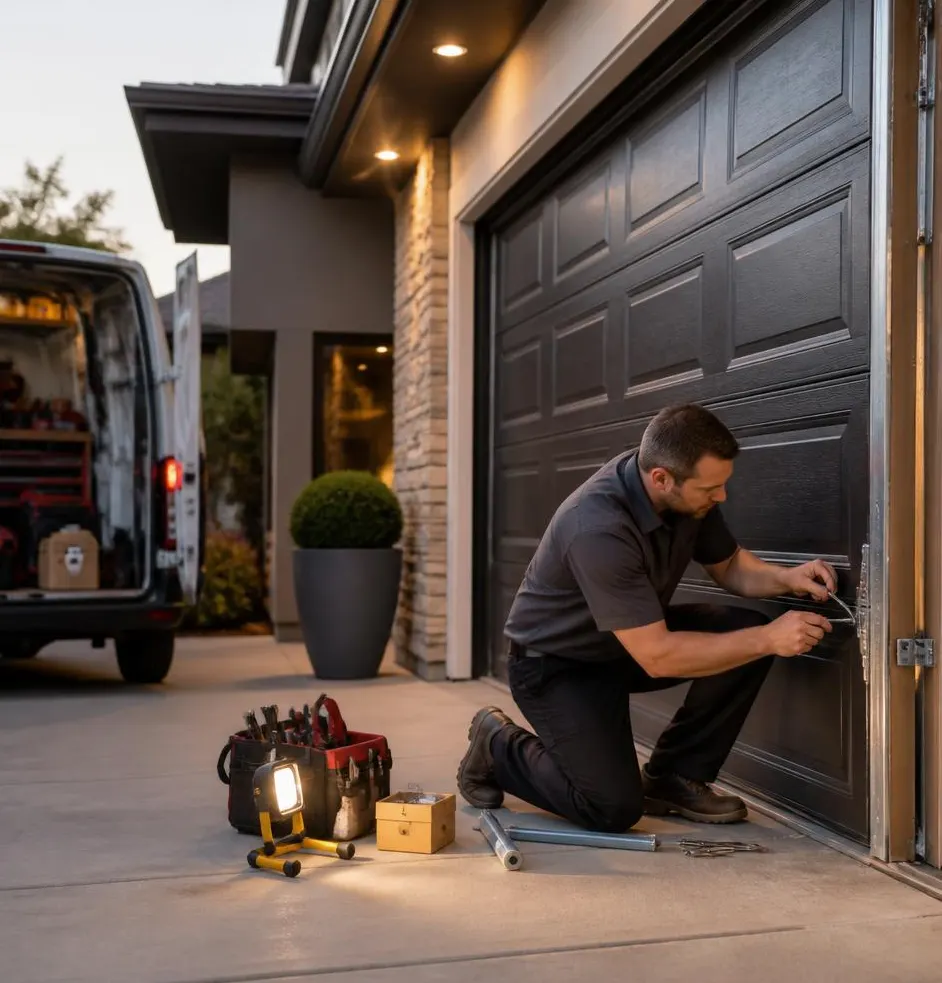
What a Technician Sees on a Typical Call
Most calls about this start the same way: the homeowner says the door is "jumping" or "grinding" partway through its travel, or it stopped closing flush with the floor on one side. When a technician gets the door open and looks along the track rails with a flashlight, there is usually a visible kink, a gap between the rollers and the rail, or a bracket that has pulled away from the wall. In this part of Florida, that combination of symptoms often traces back to a mix of moisture, impact, and age working on the hardware at the same time.
Symptoms Homeowners Report First
- Grinding or scraping noise as the door moves, usually loudest at one spot in the travel path
- Door hangs crooked when open, or one side sits lower than the other when closed
- Visible gap between the door and the weatherstrip on one side, letting in light or rain
- Rollers popping out of the track or riding on the edge instead of inside the channel
- Door reverses or stops partway through the opener cycle because the safety sensors read resistance
- A section of rail that is visibly bowed, twisted, or pulled away from its mounting brackets
Left alone, any of these will get worse. A door fighting a bent track puts extra strain on the opener motor, the cables, and eventually the springs, turning a track problem into a multi-part repair.
Causes, in the Order a Technician Checks Them
1. Loose or Shifted Mounting Brackets
This is the first thing checked because it is the most common and the easiest to confirm. The brackets that hold the vertical track to the door frame work loose over time from daily vibration, and in this climate that process speeds up because humidity causes wood framing to swell and shrink through the seasons. A bracket that was snug in the dry months can work loose once the frame swells again. The fix is straightforward: re-tighten or re-anchor the brackets, and replace any that have stripped out the wood they were screwed into.
2. Impact Damage
Next, the technician looks for a dent or sharp bend that suggests something hit the track — a car bumper, a bike, a lawn mower, or storm debris during one of the afternoon downpours or tropical systems that roll through Putnam County. A light bend can sometimes be hammered back into alignment, but a sharp kink almost always means replacing that section of track, since bent steel rarely holds its shape once it has been struck hard enough to bind the rollers.
3. Door Forced Against an Obstruction
If there is no single dent but the whole track is bowed outward, the next question is whether the door was run into something stuck in its path — a stray tool, a trash can, debris blown in by wind. Pushing a motorized door against an obstruction puts steady pressure on the track rather than a single sharp hit, bowing it gradually instead of denting it. The fix here is usually a full section replacement and a check of the opener's force settings so it does not keep pushing through resistance next time.
4. Warped or Swollen Door Panels
Humidity in this area does more than loosen brackets — it can swell wood-composite panels or cause uneven expansion in older steel doors with wood cores. A door that is no longer perfectly flat pulls unevenly on both tracks as it travels, slowly working one side out of alignment even though the track itself started out straight. In these cases, straightening the track is only a temporary fix; the real solution is addressing the warped panel, which sometimes means a panel replacement rather than repeated track adjustments.
5. Rust and Corrosion at the Brackets
For homes closer to the water, salt air accelerates rust on the bolts, brackets, and track mounting points. Corroded hardware loses its grip gradually, letting the track creep out of position millimeter by millimeter until the door starts catching. A technician checks for surface rust and pitting at every mounting point, replacing corroded fasteners with new hardware and, where needed, applying a rust-resistant coating to slow the process going forward.
6. Settling or Shifting Framing
Last on the list, because it is the least common cause, is movement in the structure itself. Older garages sometimes settle unevenly, especially after heavy rain saturates the ground around the foundation. If every other cause checks out clean but the opening itself is slightly out of square, the track was never going to sit straight no matter how well it was installed. This is the one case where track repair alone will not hold, and the frame needs attention first.
When to Call Welaka Garage Door Repair
If your door is grinding, hanging crooked, or has popped a roller, it is worth having it looked at before hurricane season storms put extra wind load on a door that is already out of alignment. Our Off Track Door Repair service covers everything from re-aligning and re-anchoring brackets to replacing bent or corroded sections of track, and we check the rollers and cables at the same time since they tend to wear together. If the track keeps drifting out of alignment every few months, a Garage Door Tune-Up & Maintenance visit can catch loose hardware and early rust before it turns into a bigger repair.
If your garage door in Welaka, Palatka, Crescent City, or anywhere else in Putnam County is sticking, grinding, or hanging crooked, call Welaka Garage Door Repair and we will get it running straight and safe again.